what kind of reaction do the latin american have to the monroe doctrine
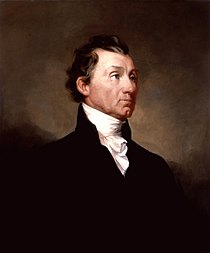
The Monroe Doctrine was a United states of america foreign policy position that opposed European colonialism in the Western Hemisphere. It held that any intervention in the political affairs of the Americas by strange powers was a potentially hostile act against the U.S.[1] The doctrine was key to U.S. foreign policy for much of the 19th and early on 20th centuries.[2]
President James Monroe showtime articulated the doctrine on December ii, 1823, during his seventh annual State of the Union Address to Congress (though it would not be named after him until 1850).[3] At the fourth dimension, nearly all Castilian colonies in the Americas had either achieved or were close to independence. Monroe asserted that the New World and the Old World were to remain distinctly separate spheres of influence,[4] and thus further efforts by European powers to control or influence sovereign states in the region would be viewed equally a threat to U.S. security.[ii] [five] In plough, the U.S. would recognize and not interfere with existing European colonies nor meddle in the internal affairs of European countries.
By the terminate of the 19th century, Monroe's declaration was seen as a defining moment in the foreign policy of the United states of america and one of its longest-continuing tenets. The intent and effect of the doctrine persisted for over a century, with only pocket-sized variations, and would be invoked past many U.South. statesmen and several U.S. presidents, including Ulysses S. Grant, Theodore Roosevelt, John F. Kennedy, and Ronald Reagan.
After 1898, the Monroe Doctrine was reinterpreted by Latin American lawyers and intellectuals as promoting multilateralism and non-intervention. In 1933, under President Franklin D. Roosevelt, the U.S. affirmed this new interpretation, namely through co-founding the Organization of American States.[6] Into the 21st century, the doctrine continues to be variably denounced, reinstated, or reinterpreted.
Seeds of the Monroe Doctrine
Despite the United States' ancestry as an neutralist country, the foundation of the Monroe Doctrine was already being laid even during George Washington's presidency. According to S.East. Morison, "as early equally 1783, then, the United States adopted the policy of isolation and appear its intention to keep out of Europe. The supplementary principle of the Monroe Doctrine, that Europe must go on out of America, was still over the horizon".[7]
While not specifically the Monroe Doctrine, Alexander Hamilton desired to control the sphere of influence in the Western Hemisphere, particularly in N America, [ failed verification ] but this was extended to the Latin American colonies past the Monroe Doctrine.[8] Merely Hamilton, writing in the Federalist Papers, was already wanting to establish the United States every bit a earth power and hoped that it would suddenly get strong enough to go along the European powers outside of the Americas, despite the fact that the European countries controlled much more of the Americas than the U.S. herself.[7] Hamilton expected that the United States would become the dominant power in the New Earth and would, in the futurity, human activity as an intermediary betwixt the European powers and any new countries blossoming well-nigh the U.South.[7]
A note from James Madison (Thomas Jefferson'south Secretary of State and a time to come president) to the U.Southward. administrator to Spain, expressed the American federal government's opposition to further territorial conquering past European powers.[9] Madison's sentiment might have been meaningless because, as was noted earlier, the European powers held much more than territory in comparing to the territory held by the U.S. Although Thomas Jefferson was pro-French, in an attempt to keep the British–French rivalry out the U.Southward., the federal government nether Jefferson made information technology clear to its ambassadors that the U.S. would not support any future colonization efforts on the North American continent.
The U.S. regime feared the victorious European powers that emerged from the Congress of Vienna (1814–1815) would revive monarchical authorities. France had already agreed to restore the Castilian monarchy in exchange for Cuba.[ten] Every bit the revolutionary Napoleonic Wars (1803–1815) ended, Prussia, Austria, and Russia formed the Holy Alliance to defend monarchism. In detail, the Holy Alliance authorized military incursions to re-establish Bourbon dominion over Kingdom of spain and its colonies, which were establishing their independence.[11] : 153–5
Bully Uk shared the general objective of the Monroe Doctrine, and fifty-fifty wanted to declare a joint statement to go on other European powers from further colonizing the New Earth. The British feared their trade with the New World would be harmed if the other European powers further colonized it. In fact, for many years later the doctrine took upshot, Britain, through the Royal Navy, was the sole nation enforcing it, the U.S. lacking sufficient naval capability.[viii] The U.S. resisted a joint statement because of the recent memory of the War of 1812; however, the firsthand provocation was the Russian Ukase of 1821[12] asserting rights to the Pacific Northwest and forbidding not-Russian ships from budgeted the coast.[13] [fourteen]
Doctrine
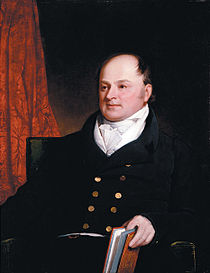
The total certificate of the Monroe Doctrine, written importantly by future-President and then-Secretary of State John Quincy Adams, is long and couched in diplomatic language, merely its essence is expressed in two primal passages. The first is the introductory statement, which asserts that the New Globe is no longer subject to colonization by the European countries:[15]
The occasion has been judged proper for asserting, every bit a principle in which the rights and interests of the Usa are involved, that the American continents, by the costless and independent condition which they have assumed and maintain, are henceforth not to exist considered equally subjects for future colonization by any European powers.
The second key passage, which contains a fuller argument of the Doctrine, is addressed to the "allied powers" of Europe; information technology clarifies that the U.S. remains neutral on existing European colonies in the Americas merely is opposed to "interpositions" that would create new colonies amidst the newly independent Spanish American republics:[5]
We owe it, therefore, to artlessness and to the amicable relations existing betwixt the United States and those powers to declare that nosotros should consider any endeavor on their function to extend their system to any portion of this hemisphere every bit dangerous to our peace and safety. With the existing colonies or dependencies of any European power, we have non interfered and shall not interfere. Simply with the Governments who have declared their independence and maintained information technology, and whose independence we have, on great consideration and on just principles, acknowledged, we could non view any interposition for the purpose of oppressing them, or controlling in whatever other manner their destiny, by any European power in any other low-cal than as the manifestation of an unfriendly disposition toward the United states of america.
Effects

Gillam's 1896 political cartoon, Uncle Sam stands with rifle between the Europeans and Latin Americans
International response
Because the U.S. lacked both a credible navy and army at the time, the doctrine was largely disregarded internationally.[iv] Prince Metternich of Austria was angered by the argument, and wrote privately that the doctrine was a "new act of revolt" by the U.S. that would grant "new strength to the apostles of sedition and reanimate the courage of every conspirator."[eleven] : 156
The doctrine, notwithstanding, met with tacit British approval. They enforced information technology tactically as part of the wider Pax Britannica, which included enforcement of the neutrality of the seas. This was in line with the developing British policy of laissez-faire gratuitous merchandise confronting mercantilism. Fast-growing British industry sought markets for its manufactured goods, and, if the newly independent Latin American states became Castilian colonies over again, British access to these markets would be cut off by Castilian mercantilist policy.[xvi]
Latin American reaction
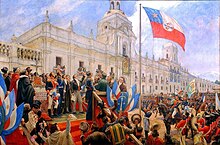
The reaction in Latin America to the Monroe Doctrine was generally favorable but on some occasions suspicious. John A. Crow, author of The Ballsy of Latin America, states, "Simón Bolívar himself, still in the midst of his concluding campaign against the Spaniards, Santander in Colombia, Rivadavia in Argentine republic, Victoria in United mexican states—leaders of the emancipation motility everywhere—received Monroe's words with sincerest gratitude".[17] Crow argues that the leaders of Latin America were realists. They knew that the president of the United States wielded very piddling power at the time, particularly without the bankroll of the British forces, and figured that the Monroe Doctrine was unenforceable if the United States stood alone against the Holy Alliance.[17] While they appreciated and praised their support in the north, they knew that the futurity of their independence was in the hands of the British and their powerful navy. In 1826, Bolivar called upon his Congress of Panama to host the first "Pan-American" meeting. In the eyes of Bolivar and his men, the Monroe Doctrine was to become nothing more than a tool of national policy. According to Crow, "It was not meant to be, and was never intended to be a charter for concerted hemispheric action".[17]
At the same time, some people questioned the intentions behind the Monroe Doctrine. Diego Portales, a Chilean businessman and minister, wrote to a friend: "Just we take to exist very careful: for the Americans of the north [from the United states of america], the just Americans are themselves".[18]
Mail service-Bolívar events

In Spanish America, Royalist guerrillas continued the war in several countries, and Spain attempted to retake Mexico in 1829. Merely Cuba and Puerto Rico remained under Spanish rule, until the Castilian–American War in 1898.
In early 1833, the British reasserted their sovereignty over the Falkland islands, thus violating the Monroe Doctrine.[xix] No action was taken by the US, and George C. Herring writes that the inaction "confirmed Latin American and especially Argentine suspicions of the Usa."[11] : 171 [20] In 1838–50 Argentine republic was under abiding naval blockade by the French navy, which was supported past the British navy, and every bit such, no action was undertaken by the U.S. to support their fellow Americas nation as Monroe had stated should be done for collective security against European colonial powers.[21] [19]
In 1842, U.S. President John Tyler practical the Monroe Doctrine to Hawaii and warned United kingdom not to interfere at that place. This began the process of annexing Hawaii to the U.South.[22]
On December 2, 1845, U.Southward. President James Polk appear that the principle of the Monroe Doctrine should be strictly enforced, reinterpreting information technology to argue that no European nation should interfere with the American western expansion ("Manifest Destiny").[23]

In 1861, Dominican military commander and royalist politician Pedro Santana signed a pact with the Spanish Crown and reverted the Dominican nation to colonial status. Espana was wary at first, but with the U.S. occupied with its own civil war, Spain believed information technology had an opportunity to reassert command in Latin America. On March 18, 1861, the Spanish annexation of the Dominican Democracy was announced. The American Ceremonious State of war ended in 1865, and following the re-assertion of the Monroe Doctrine by the United States government, this prompted the Castilian forces stationed within the Dominican Commonwealth to extradite back to Cuba inside that same year.[24]
In 1862, French forces under Napoleon III invaded and conquered Mexico, giving command to the puppet monarch Emperor Maximilian. Washington denounced this as a violation of the doctrine simply was unable to intervene because of the American Civil War. This marked the offset time the Monroe Doctrine was widely referred to as a "doctrine."[ citation needed ] In 1865 the U.S. garrisoned an army on its edge to encourage Napoleon III to leave Mexican territory, and they did afterwards remove their forces, which was followed by Mexican nationalists capturing and then executing Maximilian.[25] Subsequently the expulsion of France from United mexican states, William H. Seward proclaimed in 1868 that the "Monroe doctrine, which viii years ago was simply a theory, is now an irreversible fact."[26]
In 1865, Kingdom of spain occupied the Chincha Islands in violation of the Monroe Doctrine.[19]
In 1862, the remaining British colonies inside Belize merged into a single crown colony within the British Empire, and renamed every bit British Honduras. The U.Due south. government did not express disapproval for this action, either during or subsequently the Civil War.[27]

President Cleveland twisting the tail of the British Lion; drawing in Puck by J.Southward. Pughe, 1895
In the 1870s, President Ulysses Due south. Grant and his Secretary of State Hamilton Fish endeavored to supercede European influence in Latin America with that of the U.S. In 1870, the Monroe Doctrine was expanded under the proclamation "hereafter no territory on this continent [referring to Cardinal and S America] shall be regarded equally subject field to transfer to a European power."[xi] : 259 Grant invoked the Monroe Doctrine in his failed attempt to annex the Dominican Republic in 1870.[28]
The Venezuelan crisis of 1895 became "one of the most momentous episodes in the history of Anglo-American relations in general and of Anglo-American rivalries in Latin America in particular."[29] Venezuela sought to involve the U.S. in a territorial dispute with United kingdom of great britain and northern ireland over Guayana Esequiba, and hired old Us ambassador William L. Scruggs to argue that British behaviour over the issue violated the Monroe Doctrine. President Grover Cleveland through his Secretarial assistant of Country, Richard Olney, cited the Doctrine in 1895, threatening strong action confronting Great Britain if the British failed to intervene their dispute with Venezuela. In a July 20, 1895 note to Britain, Olney stated, "The United States is practically sovereign on this continent, and its fiat is law upon the subjects to which it confines its interposition."[11] : 307 British Prime number Minister Lord Salisbury took strong exception to the American linguistic communication. The U.S. objected to a British proposal for a joint meeting to clarify the scope of the Monroe Doctrine. Historian George Herring wrote that by failing to pursue the issue further the British "tacitly conceded the U.Southward. definition of the Monroe Doctrine and its hegemony in the hemisphere."[11] : 307–8 Otto von Bismarck, did not hold and in October 1897 chosen the Doctrine an "uncommon insolence".[30] Sitting in Paris, the Tribunal of Arbitration finalized its decision on Oct 3, 1899.[29] The award was unanimous, but gave no reasons for the conclusion, merely describing the resulting boundary, which gave Great britain almost 90% of the disputed territory[31] and all of the gold mines.[32]
The reaction to the award was surprise, with the accolade'south lack of reasoning a particular concern.[31] The Venezuelans were keenly disappointed with the outcome, though they honored their counsel for their efforts (their delegation's secretarial assistant, Severo Mallet-Prevost, received the Order of the Liberator in 1944), and abided by the award.[31]
The Anglo-Venezuelan boundary dispute asserted for the first fourth dimension a more outward-looking American strange policy, particularly in the Americas, marking the U.S. as a world power. This was the earliest instance of modern interventionism under the Monroe Doctrine in which the USA exercised its claimed prerogatives in the Americas.[33]

In 1898, the U.S. intervened in support of Cuba during its war for independence from Espana. The resulting Spanish–American War ended in a peace treaty requiring Spain to cede Puerto Rico, the Philippines, and Guam to the U.S. in exchange for $20 million. Spain was additionally forced to recognize Cuban independence, though the isle remained under U.S. occupation until 1902.[34]
"Big Blood brother"

American poses with dead Haitian revolutionaries killed by United states of america Marine motorcar gun burn, 1915.
The "Large Blood brother" policy was an extension of the Monroe Doctrine formulated past James G. Blaine in the 1880s that aimed to rally Latin American nations behind US leadership and open up their markets to US traders. Blaine served as Secretary of State in 1881 under President James A. Garfield and again from 1889 to 1892 under President Benjamin Harrison. Every bit a function of the policy, Blaine arranged and led the Offset International Conference of American States in 1889.[35]
"Olney Corollary"
The Olney Corollary, also known every bit the Olney interpretation or Olney declaration was United States Secretary of State Richard Olney'south estimation of the Monroe Doctrine when the border dispute for Guayana Esequiba occurred between the British and Venezuelan governments in 1895. Olney claimed that the Monroe Doctrine gave the U.S. authority to mediate border disputes in the Western Hemisphere. Olney extended the meaning of the Monroe Doctrine, which had previously stated just that the Western Hemisphere was closed to additional European colonization. The statement reinforced the original purpose of the Monroe Doctrine, that the U.Southward. had the correct to intervene in its own hemisphere and foreshadowed the events of the Castilian–American War iii years afterwards. The Olney interpretation was defunct by 1933.[36]
Canada
In 1902, Canadian Prime Government minister Wilfrid Laurier acknowledged that the Monroe Doctrine was essential to his land's protection. The doctrine provided Canada with a de facto security guarantee by the Us; the U.s. Navy in the Pacific, and the British Navy in the Atlantic, made invading North America almost impossible. Because of the peaceful relations between the two countries, Canada could assist Great britain in a European war without having to defend itself at domicile.[37]
"Roosevelt Corollary"

1903 cartoon: "Go Away, Little Man, and Don't Bother Me". President Roosevelt intimidating Republic of colombia to acquire the Panama Culvert Zone.
The Doctrine's authors, chiefly time to come-President and then Secretary-of-Country John Quincy Adams, saw it as a declaration past the U.Due south. of moral opposition to colonialism, simply it has subsequently been re-interpreted and practical in a variety of instances. Equally the U.S. began to emerge as a globe power, the Monroe Doctrine came to ascertain a recognized sphere of command that few dared to challenge.[4]
Before becoming president, Theodore Roosevelt had proclaimed the rationale of the Monroe Doctrine in supporting intervention in the Spanish colony of Cuba in 1898.[ citation needed ] The Venezuela Crisis of 1902–1903 showed the world that the U.S. was willing to employ its naval strength to intervene to stabilize the economic affairs of small-scale states in the Caribbean and Central America if they were unable to pay their international debts, in order to preclude European intervention to do so.[38] The Venezuela crisis, and in particular the arbitral award, were fundamental in the development of the Corollary.[38]
In Argentine strange policy, the Drago Doctrine was announced on Dec 29, 1902, by the foreign minister of Argentina, Luis María Drago. The doctrine itself was a response to the actions of Great britain, Deutschland, and Italia, which, in 1902, had blockaded Venezuela in response to Venezuelan government's refusal to pay its massive foreign debt that had been acquired under previous administrations before President Cipriano Castro took ability. Drago set forth the policy that no European power could use strength confronting an American nation to collect debt owed. President Theodore Roosevelt rejected this policy every bit an extension of the Monroe Doctrine, declaring, "We do not guarantee any state confronting punishment if it misconducts itself".[11] : 370
Instead, Roosevelt added the Roosevelt Corollary to the Monroe Doctrine in 1904, asserting the right of the U.S. to intervene in Latin America in cases of "flagrant and chronic wrongdoing by a Latin American Nation" to preempt intervention by European creditors. This re-interpretation of the Monroe Doctrine went on to be a useful tool to take economic benefits by forcefulness when Latin nations failed to pay their debts to European and US banks and business interests. This was likewise referred to as the Big Stick ideology because of the often-quoted phrase from President Roosevelt, "speak softly and carry a big stick".[4] [11] : 371 [39] The Roosevelt corollary provoked outrage across Latin America.[40]
The Roosevelt Corollary was invoked to intervene militarily in Latin America to finish the spread of European influence.[39] It was the well-nigh significant amendment to the original doctrine and was widely opposed by critics, who argued that the Monroe Doctrine was originally meant to finish European influence in the Americas.[four] They argued that the Corollary merely asserted U.Due south. domination in that area, effectively making them a "hemispheric policeman."[41]
Lodge Resolution
The so-chosen "Social club Resolution" was passed[42] by the U.S. Senate on August 2, 1912, in response to a reported endeavor by a Nippon-backed individual company to acquire Magdalena Bay in southern Baja California. It extended the reach of the Monroe Doctrine to cover actions of corporations and associations controlled by foreign states.[43]
Global Monroe Doctrine
Scholars such equally Neil Smith have written that Woodrow Wilson finer proposed a "Global Monroe Doctrine" expanding Usa supremacy over the unabridged world.[ citation needed ] Some analysts[ who? ] assert that this prerogative for indirect control and sporadic invasions and occupations beyond the planet has largely come to fruition with the American superpower role since World War II. Such a expansion of the doctrine is premised on the "nominal equality" of independent states. Such superficial equality is often undermined past material inequality, making the US a de facto global empire.[44] Smith argued that the founding of the Un played a office in the establishing this global protectorate state of affairs.[45]
Clark Memorandum
The Clark Memorandum, written on December 17, 1928, by Calvin Coolidge's undersecretary of state J. Reuben Clark, concerned U.S. utilize of military force to intervene in Latin American nations. This memorandum was officially released in 1930 past the Herbert Hoover administration.
The Clark memorandum rejected the view that the Roosevelt Corollary was based on the Monroe Doctrine. However, it was non a consummate repudiation of the Roosevelt Corollary but was rather a statement that any intervention by the U.Due south. was not sanctioned by the Monroe Doctrine but rather was the right of the U.S. every bit a state. This separated the Roosevelt Corollary from the Monroe Doctrine by noting that the Monroe Doctrine only applied to situations involving European countries. One main betoken in the Clark Memorandum was to notation that the Monroe Doctrine was based on conflicts of interest simply between the United States and European nations, rather than between the United States and Latin American nations.
World War II
After World War II began, a majority of Americans supported defending the entire Western Hemisphere against foreign invasion. A 1940 national survey establish that 81% supported defending Canada; 75% Mexico and Central America; 69% South America; 66% W Indies; and 59% Greenland.[46]
The December 1941 conquest of Saint Pierre and Miquelon by the forces of Free France from out of the command of Vichy France was seen as a violation of the Monroe Doctrine by Secretary of Country Cordell Hull.[47]
Latin American reinterpretation
Later on 1898, jurists and intellectuals in Argentina, Brazil, Chile, and Uruguay, especially Luis María Drago, Alejandro Álvarez and Baltasar Brum, reinterpreted the Monroe doctrine. They sought a fresh continental approach to international law in terms of multilateralism and non-intervention. Indeed, an alternative Spanish American origin of the idea was proposed, attributing it to Manuel Torres.[48] However, American leaders were reluctant to renounce unilateral interventionism until the Skilful Neighbor policy enunciated by President Franklin Roosevelt in 1933. The era of the Good Neighbor Policy ended with the ramp-up of the Cold War in 1945, as the United States felt there was a greater need to protect the western hemisphere from Soviet influence. These changes conflicted with the Skilful Neighbor Policy's key principle of non-intervention and led to a new wave of US involvement in Latin American affairs. Control of the Monroe doctrine thus shifted to the multilateral System of American States (OAS) founded in 1948.[6]
In 1954, Secretary of State John Foster Dulles invoked the Monroe Doctrine at the 10th Pan-American Briefing in Caracas, Venezuela, denouncing the intervention of Soviet Communism in Guatemala. President John F. Kennedy said at an August 29, 1962 news conference:
The Monroe Doctrine ways what information technology has meant since President Monroe and John Quincy Adams enunciated it, and that is that we would oppose a strange power extending its power to the Western Hemisphere [sic], and that is why nosotros oppose what is happening in Republic of cuba today. That is why we take cut off our trade. That is why nosotros worked in the OAS and in other ways to isolate the Communist menace in Cuba. That is why we will proceed to give a good deal of our effort and attention to it.[49]
Cold War

The U.S.-supported Nicaraguan contras
During the Common cold War, the Monroe Doctrine was practical to Latin America by the framers of U.S. strange policy.[l] When the Cuban Revolution (1953–1959) established a Communist authorities with ties to the Soviet Union, it was argued that the Monroe Doctrine should exist invoked to forestall the spread of Soviet-backed Communism in Latin America.[51] Nether this rationale, the U.Southward. provided intelligence and military aid to Latin and South American governments that claimed or appeared to be threatened by Communist subversion (as in the example of Operation Condor).
In the Cuban Missile Crunch of 1962, President John F. Kennedy cited the Monroe Doctrine every bit grounds for the United states' confrontation with the Soviet Union over the installation of Soviet ballistic missiles on Cuban soil.[52]
The fence over this new estimation of the Monroe Doctrine burgeoned in reaction to the Iran–Contra affair. It was revealed that the U.S. Cardinal Intelligence Agency had been covertly preparation "Contra" guerrilla soldiers in Honduras in an attempt to destabilize and overthrow the Sandinista revolutionary authorities of Nicaragua and its president, Daniel Ortega. CIA manager Robert Gates vigorously defended the Contra performance in 1984, arguing that eschewing U.S. intervention in Nicaragua would exist "totally to abandon the Monroe Doctrine".[53]
21st-century approaches
Kerry Doctrine
President Barack Obama's Secretary of Country John Kerry told the Organization of American States in November 2013 that the "era of the Monroe Doctrine is over."[54] Several commentators have noted that Kerry'south call for a mutual partnership with the other countries in the Americas is more in keeping with Monroe's intentions than the policies enacted after his death.[55]
America First
President Donald Trump implied potential use of the doctrine in August 2017 when he mentioned the possibility of war machine intervention in Venezuela,[56] after his CIA Managing director Mike Pompeo declared that the nation'south deterioration was the effect of interference from Iranian- and Russian-backed groups.[57] In February 2018, Secretary of State King Tillerson praised the Monroe Doctrine equally "clearly … a success", alarm of "imperial" Chinese trade ambitions and touting the U.s. as the region'south preferred trade partner.[58] Pompeo replaced Tillerson as Secretarial assistant of State in May 2018. Trump reiterated his commitment to the implementation of the Monroe Doctrine at the 73rd UN Full general Associates in 2018.[59] Vasily Nebenzya criticised the Us for what the Russian Federation perceives as an implementation of the Monroe Doctrine at the 8452nd emergency meeting of the United Nations Security Council on January 26, 2019. Venezuela's representative listed 27 interventions in Latin America that Venezuela considers to exist implementations of the Monroe Doctrine : 20–21 and stated that, in the context of the statements, they consider it "a direct military threat to the Bolivarian Republic of Venezuela". : 47 Cuba's representative formulated a similar stance, "The electric current Administration of the The states has alleged the Monroe Doctrine to be in effect..." : 28 [60]
On March iii, 2019, National Security Advisor John Bolton invoked the Monroe Doctrine in describing the Trump administration'south policy in the Americas, saying "In this administration, we're not afraid to use the word Monroe Doctrine...It's been the objective of American presidents going dorsum to President Ronald Reagan to have a completely democratic hemisphere."[61] [62]
Criticism
Historians accept observed that while the Doctrine contained a delivery to resist further European colonialism in the Americas, it resulted in some aggressive implications for American strange policy, since at that place were no limitations on the US's own deportment mentioned inside it. Historian Jay Sexton notes that the tactics used to implement the doctrine were modeled after those employed by European majestic powers during the 17th and 18th centuries.[63] American historian William Appleman Williams, seeing the doctrine every bit a class of American imperialism, described it as a form of "royal anti-colonialism".[64] Noam Chomsky argues that in practice the Monroe Doctrine has been used by the U.S. regime every bit a declaration of hegemony and a right of unilateral intervention over the Americas.[65]
See too
- Banana Wars
- Foreign policy of the United States
- Gunboat affairs
- Latin America–United States relations
- Monroe Doctrine Centennial half dollar
References
- ^ Mark T. Gilderhus, "The Monroe doctrine: meanings and implications." Presidential Studies Quarterly 36.1 (2006): five–16 online.
- ^ a b "Monroe Doctrine". HISTORY . Retrieved December ii, 2021.
- ^ "Monroe Doctrine". Oxford English Dictionary (3rd ed.). 2002.
- ^ a b c d e New Encyclopædia Britannica. Vol. viii (15th ed.). Encyclopædia Britannica. p. 269. ISBN1-59339-292-iii.
- ^ a b "The Monroe Doctrine (1823)". Basic Readings in U.Due south. Republic. U.s.a. Department of State. Archived from the original on Jan 8, 2012.
- ^ a b Scarfi, Juan Pablo (2014). "In the Name of the Americas: The Pan-American Redefinition of the Monroe Doctrine and the Emerging Language of American International Police force in the Western Hemisphere, 1898–1933". Diplomatic History. 40 (two): 189–218. doi:10.1093/dh/dhu071.
- ^ a b c Morison, S.E. (February 1924). "The Origins of the Monroe Doctrine". Economica (10): 27–51. doi:10.2307/2547870. JSTOR 2547870.
- ^ a b "Monroe Doctrine, 1823". Part of the Historian. The states Department of State. April 6, 2016. Retrieved March 26, 2016.
- ^ Nerval, Gaston (1934). Autopsy of the Monroe Doctrine. New York: The Macmillan Visitor. p. 33.
- ^ Boyer, Paul South., ed. (2006). The Oxford Companion to Usa History. Oxford: Oxford Academy Press. pp. 514. ISBN978-0-19-508209-8.
- ^ a b c d east f g h Herring, George C. (2008). From Colony to Superpower: U.Due south. Strange Relations Since 1776. New York: Oxford University Printing. ISBN9780195078220.
- ^ For the text of the Ukase of 1821, encounter: "Imperial Russian Edicts Relating to the Russian–American Company". Fur-Seal Mediation: Appendix to the Case of the Usa Before the Tribunal of Arbitration to Convene at Paris Under the Provisions of the Treaty Between the U.s.a. and Corking United kingdom, Ended Feb 29, 1892. Washington, DC: U.South. Government Printing Office. 1892. p. xvi.
- ^ Kennedy, David G.; Cohen, Lizabeth; Bailey, Thomas Andrew (2008). The American Pageant: A History of the Republic, Volume I. Cengage Learning. p. 267. ISBN9780547166599.
- ^ Miller, Robert J.; Furse, Elizabeth (2006). Native America, Discovered and Conquered: Thomas Jefferson, Lewis & Clark, and Manifest Destiny. Westport, CT: Praeger. p. 136. ISBN9780275990114.
- ^ Monroe, James. "The Monroe Doctrine". U.S. Department of State. Retrieved November 2, 2011.
- ^ Hobson, Rolf (2002). Imperialism at Sea. Vol. 163. Brill Bookish Publishers. p. 63. ISBN978-0-391-04105-9 . Retrieved October 12, 2009.
- ^ a b c Crow, John A. (1992). "Areil and Caliban". The Epic of Latin America (4th ed.). Berkeley: Academy of California Press. pp. 676. ISBN0-520-07723-7.
- ^ Uribe, Armando, El Libro Negro de la Intervención Norteamericana en Chile. México: Siglo XXI Editores, 1974.
- ^ a b c Castro-Ruiz, Carlos (1917). "The Monroe Doctrine and the Authorities of Chile". American Political Science Review. 11 (two): 231–238. doi:10.2307/1943985. ISSN 0003-0554. JSTOR 1943985.
- ^ Howe, Daniel (2007). What Hath God Wrought . New York: Oxford Academy Press. p. 115. ISBN978-0-19-507894-7.
- ^ "What is the Monroe Doctrine?". The Economist. ISSN 0013-0613. Retrieved July 14, 2020.
- ^ Debra J. Allen (2012). Historical Dictionary of U.S. Diplomacy from the Revolution to Secession. Scarecrow Press. p. 270. ISBN9780810878952.
- ^ no past-line. "James K. Polk: Reaffirmation of the Monroe Doctrine". Encyclopædia Britannica . Retrieved July 28, 2016.
In his message to Congress of Dec ii, 1845, President Polk reinterpreted the Monroe Doctrine in terms of the prevailing spirit of Manifest Destiny. Whereas Monroe had said just that the Western Hemisphere was no longer open to European colonialism, Polk now stated that European nations had ameliorate not interfere with projected territorial expansion by the U.S.
- ^ "Annexation by Spain, 1861–65". U.S. Library of Congress.
- ^ M. M. McAllen, Maximilian and Carlota: Europe'southward Last Empire in Mexico (2014)
- ^ Maass, Richard W. (2020). The Picky Eagle: How Democracy and Xenophobia Limited U.Southward. Territorial Expansion. Cornell Academy Printing. p. 154. ISBN978-i-5017-4875-2.
- ^ Byrne, James Patrick; Coleman, Philip; Male monarch, Jason Francis (2008). Ireland and the Americas. ISBN9781851096145.
- ^ Ulysses Simpson Grant; John Y. Simon, Editor (1998). The Papers of Ulysses S. Grant: November 1, 1870 – May 31, 1871. SIU Printing. p. 286. ISBN9780809321971.
- ^ a b Humphreys, R. A. (1967). Anglo-American Rivalries and the Venezuela Crisis of 1895: Presidential Accost to the Royal Historical Society December ten, 1966. Transactions of the Royal Historical Society. Vol. 17. pp. 131–164.
- ^ "Bismarck and the Monroe Doctrine". Chicago Tribune. October 20, 1897. Retrieved Baronial 16, 2016.
- ^ a b c Schoenrich (1949:526)
- ^ King (2007:260)
- ^ Ferrell, Robert H. "Monroe Doctrine". ap.grolier.com. Archived from the original on March 21, 2008. Retrieved October 31, 2008.
- ^ Smith, Joseph (2014). The Castilian–American War 1895–1902: Conflict in the Caribbean and the Pacific. Routledge. ISBN978-1-138-83742-3.
- ^ Lens, Sidney; Zinn, Howard (2003). The Forging of the American Empire: From the Revolution to Vietnam, a History of U.S. Imperialism. Human Security Series (Illustrated ed.). Pluto Press. p. 464. ISBN0-7453-2100-iii.
- ^ Immature, George B. (1942). "Intervention Under the Monroe Doctrine: The Olney Corollary". Political Scientific discipline Quarterly. 57 (2): 247–280. doi:x.2307/2143553. JSTOR 2143553.
- ^ Dziuban, Stanley Westward. (1959). "Chapter 1, Chautauqua to Ogdensburg". Military machine Relations Betwixt the U.s. and Canada, 1939–1945. Washington DC: Center of War machine History, United States Army. pp. 2–iii. LCCN 59-60001. Archived from the original on May seven, 2019. Retrieved December 2, 2016.
- ^ a b Matthias Maass (2009), "Goad for the Roosevelt Corollary: Arbitrating the 1902–1903 Venezuela Crisis and Its Bear on on the Development of the Roosevelt Corollary to the Monroe Doctrine", Diplomacy & Statecraft, Volume 20, Upshot iii, pages 383–402
- ^ a b Roosevelt, Theodore (December vi, 1904). "Land of the Union Address". TeachingAmericanHistory.org. Archived from the original on June 13, 2010. Retrieved December twenty, 2008.
- ^ Thomas Leonard; et al. (2012). Encyclopedia of U.S. – Latin American Relations. SAGE. p. 789. ISBN9781608717927.
- ^ Lerner, Adrienne Wilmoth (2004). "Monroe Doctrine". Encyclopedia of Espionage, Intelligence, and Security.
- ^ "Senate Vote #236 in 1912".
- ^ New York Times Current History: the European war, Volume 9. 1917. pp. 158–159.
- ^ McGranahan, Carole; Collins, John F. (August two, 2018). "Chapter 18". Ethnographies of U.S. Empire. Duke University Printing. ISBN9781478002086.
- ^ Smith, Neil (March 19, 2003). American Empire: Roosevelt'southward Geographer and the Prelude to Globalization . Academy of California Press. pp. 406–419. ISBN9780520230279.
global monroe doctrine.
- ^ "What the U.S.A. Thinks". Life. July 29, 1940. p. 20. Retrieved November ten, 2011.
- ^ "Over by Christmas." The Liberation of Saint Pierre and Miquelon
- ^ Chandler, Charles Lyon (July 1914). "The Pan American Origin of the Monroe Doctrine". American Periodical of International Law. 8 (iii): 515–519. doi:10.2307/2187493; García Samudio, Nicolás (1941). "La misíon de don Manuel Torres en Washington y los orígenes suramericanos de la doctrina Monroe". Boletín de Historia y Antigüedades (in Castilian). 28: 474–484; criticized past Whitaker, Arthur P. (1954). The Western Hemisphere Idea: Its Rise and Decline. Ithaca, New York: Cornell University Printing. p. 27.
- ^ "352 – The President's News Conference August 29, 1962 response to Q[21.]". Gerhard Peters and John T. Woolley, The American Presidency Projection.
- ^ Dominguez, Jorge (1999). "United states–Latin American Relations During the Cold War and its Backwash" (PDF). The United States and Latin America: The New Agenda. Found of Latin American Studies and the David Rockefeller Center for Latin Americas Studies. p. 12. Retrieved August 4, 2010.
- ^ "Study Prepared in Response to National Security Report Memorandum 15". NSC–IG/ARA. July 5, 1969. Retrieved August 4, 2010.
- ^ "The Durable Doctrine". Time. September 21, 1962. Archived from the original on March 6, 2009. Retrieved July xv, 2009.
- ^ Smith, Gaddis (1995). The Last Years of the Monroe Doctrine, 1945–1993 . New York: Hill & Wang. p. 201. ISBN978-0-8090-1568-9.
- ^ Johnson, Keith (Nov xviii, 2013). "Kerry Makes It Official: 'Era of Monroe Doctrine Is Over'". Wall Street Periodical.
- ^ Keck, Zachary (November 21, 2013). "The US Renounces the Monroe Doctrine?". The Diplomat . Retrieved Nov 28, 2013.
- ^ "Trump Says He Is Because Armed services Activeness in Venezuela". VOA News.
- ^ "CIA Director Pompeo: Venezuela'due south Situation Continues to Deteriorate". VOA News.
- ^ Gramer, Robbie. "Tillerson Praises Monroe Doctrine, Warns Latin America of 'Purple' Chinese Ambitions". Foreign Policy. The Slate Group.
- ^ "Remarks past President Trump to the 73rd Session of the Un General Assembly, New York, NY". whitehouse.gov. September 25, 2018 – via National Archives.
- ^ "Due south/PV.8452 Security Quango: Seventy-4th year: 8452nd meeting". United Nations. January 26, 2019. p. 12.
- ^ "John Bolton: 'We're not afraid to employ the word Monroe Doctrine'". March 3, 2019. Retrieved March 4, 2019.
- ^ "What is the Monroe Doctrine? John Bolton's justification for Trump's push against Maduro". The Washington Postal service. March 4, 2019.
- ^ Preston, Andrew; Rossinow, Doug (November xv, 2016). Exterior In: The Transnational Circuitry of US History. Oxford Academy Printing. ISBN9780190459871.
- ^ Sexton, Jay (March 15, 2011). The Monroe Doctrine: Empire and Nation in Nineteenth-Century America. Farrar, Straus and Giroux. pp. ii–9. ISBN9781429929288.
- ^ Chomsky, Noam (2004). Hegemony Or Survival. Henry Holt. pp. 63–64. ISBN978-0-8050-7688-2 . Retrieved December 20, 2008.
Farther reading
- "Present Status of the Monroe Doctrine". Register of the American Academy of Political and Social Scientific discipline. 54: 1–129. 1914. ISSN 0002-7162. JSTOR i242639. 14 articles by experts
- Bemis, Samuel Flagg. John Quincy Adams and the Foundations of American Foreign Policy (1949) online
- Bingham, Hiram. The Monroe Doctrine: An Obsolete Shibboleth (Yale University Press, 1913); a strong attack; online
- Bolkhovitinov, Nikolai N., and Basil Dmytryshyn. "Russia and the Declaration of the not-colonization principle: new archival bear witness." Oregon Historical Quarterly 72.2 (1971): 101-126. online
- Bryne, Alex. The Monroe Doctrine and U.s.a. National Security in the Early on Twentieth Century (Springer Nature, 2020).
- Gilderhus, Marker T. (2006) "The Monroe Doctrine: meanings and implications." Presidential Studies Quarterly 36.1 (2006): v–16. Online
- May, Ernest R. (1975). The Making of the Monroe Doctrine . Harvard UP. ISBN9780674543409.
- May, Robert East. (2017) "The Irony of Confederate Diplomacy: Visions of Empire, the Monroe Doctrine, and the Quest for Nationhood." Periodical of Southern History 83.1 (2017): 69-106. excerpt
- Meiertöns, Heiko (2010). The Doctrines of U.s. Security Policy: An Evaluation under International Law. Cambridge Academy Press. ISBN978-0-521-76648-7.
- Merk, Frederick (1966). The Monroe Doctrine and American Expansionism, 1843–1849 . New York, Knopf.
- Murphy, Gretchen (2005). Hemispheric Imaginings: The Monroe Doctrine and Narratives of U.S. Empire. Duke Academy Printing. Examines the cultural context of the doctrine. excerpt
- Nakajima, Hiroo. "The Monroe Doctrine and Russia: American views of Czar Alexander I and their influence upon early Russian-American relations." Diplomatic History 31.3 (2007): 439-463.
- Perkins, Dexter (1927). The Monroe Doctrine, 1823–1826. 3 vols.
- Poston, Brook. (2016) "'Bolder Attitude': James Monroe, the French Revolution, and the Making of the Monroe Doctrine" Virginia Magazine of History and Biography 124#4 (2016), pp. 282–315. online
- Rossi, Christopher R. (2019) "The Monroe Doctrine and the Standard of Culture." Whiggish International Law (Brill Nijhoff, 2019) pp. 123–152.
- Sexton, Jay (2011). The Monroe Doctrine: Empire and Nation in 19th-Century America. Colina & Wang. 290 pages; competing and evolving conceptions of the doctrine afterward 1823. extract
Primary sources
- Alvarez, Alejandro, ed. The Monroe Doctrine: Its Importance in the International Life of united states of the New Earth (Oxford University Press, 1924) includes staements from many countries online.
External links

- Monroe Doctrine and related resources at the Library of Congress
- Selected text from Monroe'due south December 2, 1823 speech communication
- Adios, Monroe Doctrine: When the Yanquis Go Habitation by Jorge One thousand. Castañeda, The New Republic, December 28, 2009
- As illustrated in a 1904 cartoon
Source: https://en.wikipedia.org/wiki/Monroe_Doctrine
0 Response to "what kind of reaction do the latin american have to the monroe doctrine"
Post a Comment